Invisible Language, Part 3: What To Do If You Have To Correct Someone

Updates from Marvin Montgomery
Sales Tip #476 From The Sales Doctor
Invisible Language, Part 3: What To Do If You Have To Correct Someone
I want to thank Tim Dimoff, President of SACS Consulting, for emailing me the information on Invisible Language. In Parts 1 and 2, we focused on what not to say. Invisible Language Part 3 tells us the proper way to respond when correcting a misunderstanding without being condescending.
Of course, there are times when correcting a misunderstanding is the right thing to do. But there is a way to do it without being condescending? Stop and ask yourself, what’s the benefit? Is it important? Does the benefit of the correction outweigh the risk of making this person feel stupid? If there isn’t any benefit, you’re better off biting your tongue.
You can also use what’s called the “validate-clarify-continue” technique. This is a language strategy that helps you present correct information while minimizing the risk of triggering negative emotions. For example, instead of saying “Actually, the entrance is at the back of this building,” try something like this:
(Validate their belief) “It would make sense for the entrance to be at the front, wouldn’t it!”
(Clarify) “For some reason, the entrance here is at the back.”
(Continue–with a question to move the conversation forward) “Do you know how to get around there?”


Invisible Language, Part 2: “Like I Told You Before”

Updates from Marvin Montgomery
Sales Tip #475 From The Sales Doctor
Invisible Language, Part 2: “Like I Told You Before”

Here is another guaranteed customer service killer. Saying “Like I told you before.” This phrase only serves one purpose: to vent your frustration and make the other person feel stupid. There are no benefits whatsoever to this phrase.

Sure, maybe you have already said this to a customer. Perhaps even many times. Sure, it’s frustrating. But this is where rule number one comes in: “Never make your customer feel like an idiot.” This rule holds true no matter how much of an idiot you perceive someone to be.

Invisible Language, Part 1: “Actually”

Updates from Marvin Montgomery
Sales Tip #474 From The Sales Doctor
Invisible Language, Part 1: “Actually”

In this “Invisible Language” mini-series, I’ll discuss words/phrases that should be avoided when speaking with customers. They are almost always unnecessary and only serve to belittle the listener (in our case, customers/clients).

“Actually” is the most common culprit, and it’s something we are all guilty of saying from time to time. Alone, the word “actually” is harmless. But when you use it at the beginning of a sentence, its impact significantly changes.

When someone starts a sentence with actually, we know what’s going to follow. We are about to be corrected. We are about to be told we are wrong. We’re about to feel like an idiot.

“Actually” is one of the hallmarks of serial contrarians: people who can’t seem to stop themselves from correcting others. When you comment that something is light green, they respond with “actually, its mint.”

Example Number Two is next week!

You Have To Master Before You Administer!

Updates from Marvin Montgomery
Sales Tip #473 From The Sales Doctor
You Have To Master Before You Administer!
When I heard this statement, I immediately reflected on the importance of Preparation and Practice. How much time will you spend in 2020 preparing and practicing the specific areas of the Sales Process?

Make time to reflect on the specific areas that you have not fulling mastered yet, and then schedule time for Preparation and Practice.

If you are not mastering prior to administering, you are just practicing on your customer.

Just Okay Is Not Okay!

Updates from Marvin Montgomery
Sales Tip #472 From The Sales Doctor
Just Okay Is Not Okay!
I love the series of commercials that AT&T is running that depicts different professionals who obviously are not very good based on their response. “I’m just okay.”

It immediately made me think of the Sales Profession. Are you just okay? Are you practicing on your Customers? Remember my Five P’s. Preparation and Practice Provides Peak Performance. “The way you practice is the way you play!”

Just okay is not okay!

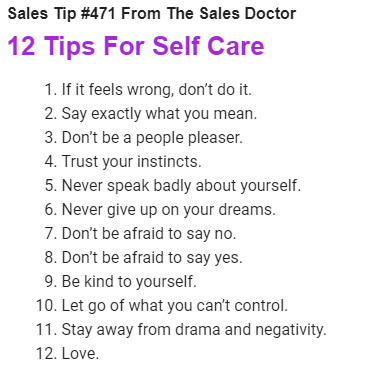
12 Tips For Self Care

Updates from Marvin Montgomery

Stop Selling And Start Solving

Updates from Marvin Montgomery
Sales Tip #470 From The Sales Doctor
Stop Selling and Start Solving
There is an old saying that I learned many years ago: “People don’t want to be
sold but they do like to buy.”

Your assignment is to determine as quickly as possible what challenges or
problems they are currently experiencing. That won’t happen if you are telling
and selling.

In simple terms, what are their pain points? Once you uncover their pain with
open-ended questions, you have an opportunity to become a solution provider
and not just another salesperson trying to sell a product or service.

Is Your Message In Sync?

Updates from Marvin Montgomery
Sales Tip #469 From The Sales Doctor
Is Your Message In Sync?
Your Words only make up 7% of your message. 38% is your Tone of Voice and 55% is your Body Language. In other words, you may think your message is in sync, but your vocal and visual message could be saying something totally different to the recipient.

That’s why preparation and practice are so important before you deliver your message. Include video so you have an opportunity to see and hear your communication. It’s an opportunity to make sure that your Verbal, Visual and Vocal are all in sync prior to your delivery.

Happy Thanksgiving from Marvin Montgomery

Thank You From The Sales Doctor
Happy Thanksgiving
As I count my blessings this Thanksgiving Day, know that all of you are among them. You have made my business what it is – and for that I am extremely grateful.
 
Have a wonderful Thanksgiving and a joyous time with family and friends.

Questions Are Our GPS!

Updates from Marvin Montgomery
Sales Tip #468 From The Sales Doctor
Questions Are Our GPS!
Questions are your Global Positioning System. The responses to your questions will let you know if you have a “yes” or a “not now.” It will put you in a winning position instead of going off in the wrong direction.